probinson@cfl.rr.com
  • Home
  • About Us
    • Board of Directors
    • What we do
  • Cons And Scams
  • Contact Us
  • Donate
  • Helpful Links
  • Members Only
    • Welcome
    • Membership Directory
    • Photo Album
    • Crimes
    • Galleries
    • Investigative Resources
    • Law Enforcement Members >
      • Intelligence Logs
      • Renew Now
      • Search
      • LE Bulletins
    • Associate Members >
      • Associate Logs
      • Associate Members Bulletins
      • Renew Now
    • Search
  • Join NABI
  • Crime Categories
  • NABI Store
  • Training And Conferences
  • New Page

NABI newsroom

JOIN OUR MAILING LIST FOR MORE INFORMATION ON ELDER FRAUD
CONTRIBUTE TO NABI
Articles shown here are for public awareness and are by no means all inclusive. They are sourced from public records, searches, and information sent by our membership across the United States, Canada, the United Kingdom, Germany, and Austria​.
SIGN UP FOR OUR FREE NEWSLETTER

05/12/2024

Be on the lookout for these scams: FTC

Picture
​No one is using your Social Security number to commit crimes. It’s a scam
The phone rings. Your caller ID says it’s the Social Security Administration. You hesitate. You’re not expecting a call from them, and you’ve heard about impersonation scams. But something inside you makes you pick up. And everything you’re about to hear is designed to scare you into doing whatever the caller says.

That text about overdue toll charges is probably a scam
When you go through a toll, you know you’ll need to pay a fee to use that road or bridge. But scammers are targeting drivers with text messages pretending to be from the tolling agency collecting “overdue toll charges.” Here’s what to know about this text scam.

Let’s talk about spam texts and emails
Another day, another round of spam texts and emails trying to sell you things. At best, spam is annoying. At worst, it’s pushing scams or trying to install malware on your device. If you’re tired of getting spam, there are some ways to help.

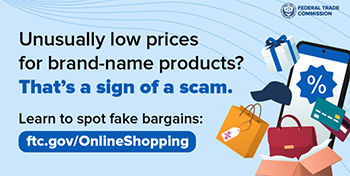
Spot an ad on social for a low, low price on a brand name product? Think twice
Social media feeds are flooded with ads offering steep discounts on brand-name products, including luxury items. But are these offers real or a scam? When a low-priced “deal” pops into your socials, take a closer look before you buy. Here’s why.

Do you really own the digital items you paid for?
Have you ever bought a video game, e-book, song, or movie to enjoy on one of your devices, whether it be a gaming console, tablet, or phone? If so, you might think that you’ll always have access to these things. But you might not — here’s why.

If someone you care about paid a scammer, here’s how to help
Sharing a scam experience with someone you know takes courage. If someone trusts you enough to share their scam story, especially if the scammer is still in touch with them, here’s some advice to help guide you.


01/07/2024

Check Washing

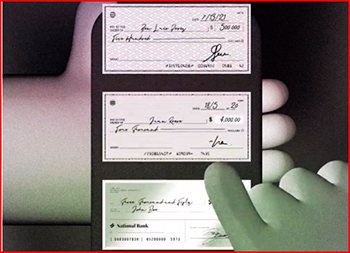
Stolen Checks Are for Sale Online

PicturePhoto from article
One reason this fraud is rampant: Open forums where anyone can buy checks that thieves have taken from the mail.

It starts with a pretty low-tech operation, after people pay bills, put checks in envelopes and drop them into a blue mailbox. At that point, criminals find ways to take them out. Or it’s an inside job at the post office, or elsewhere.

It’s a fast-growing business. During the first year of the pandemic, the Postal Service received almost 300,00 mail theft complaints, an increase of 161 percent from the previous year, according to the Financial Crimes Enforcement Network.
See Check Washing
READ THE FULL ARTICLE

01/03/2024

Robocalls

How are robocallers getting your phone number?

Picture
Here’s what to do to avoid and report robocalls.

Does it ever feel like you’re getting more robocalls than calls from actual humans? Illegal robocalls aren’t just annoying — they’re also often scams. But you might be wondering — how did they get my number in the first place?

Sometimes robocalls are random. But sometimes, a company tries to trick you to get your information and sells it. That’s what the FTC says happened with lead generation company Response Tree LLC in a settlement announced today. People looking for a quote to refinance their mortgage gave the company their name and number. But instead of giving quotes, Response Tree took people’s information and sold it to telemarketers making illegal robocalls about things like fake auto warranties, solar panels, hearing aids, and Social Security disability services.
nd scams:
  • Protect your personal information. Before you enter your personal information on a website, research it. Search the name of the site plus “complaint,” “review,” or “scam.”
  • Read the fine print. Some websites might have small disclaimers that say if you click a link or check a box, you’re agreeing to having your information collected and sold to other companies.
  • Know your rights. A robocall trying to sell you something is illegal unless the company has your written permission to call you that way.
  • Report illegal robocalls. Reporting helps law enforcement and investigators stop illegal robocalls. Report them at DoNotCall.gov.
 SOURCE

12/30/2023

Deepfake Romance Scam

​Hollywood Romance Scam: Deepfake AI Impersonates Kevin Costner

PictureImage source: Article
Imagine being swept off your feet by a Hollywood star, receiving affectionate voice notes, and engaging in intimate video calls. Now, picture the crushing realization that it was all an illusion, a meticulously crafted fraud using artificial intelligence to impersonate the actor Kevin Costner. This is the chilling reality for a Sussex woman who fell prey to an AI romance scam, highlighting the potent threat posed by deepfake technology in today’s digital age.

Rachel, a 57-year-old woman from Sussex, thought she had found love with Kevin Costner. The scammer, using AI and deepfake technology, created convincing voice notes and video calls that closely resembled the renowned actor. The deceptive scheme was so elaborate that the fraudster even impersonated Costner’s friends and family, further intensifying the illusion of a genuine relationship.

The AI Romance Scam began to crumble when the imposter requested $3,000 for a VIP membership. ...
​READ MORE


Scams

Spot red flags to avoid being a victim of scams

Picture
Spotting the red flags of scammers, according to Sgt. Tyler Rowe, public information officer for the Sikeston Department of Public Safety and Sikeston R-6 school resource officer, is crucial for avoiding falling victim to fraudsters. 
 
“What I always tell people is that if something looks too good to be true, it probably is a scam,” Rowe said. “Scammers are finding homes that are for sale or for rent and they are posting it on their own behalf on Facebook,” Rowe said.

A warning sign of a scam, according to Rowe, is if they instruct individuals to mail them the down payment and then they will send the key.

Rowe said bail bond scams are another frequent occurrence at this time of year.

This scam involves the con artist calling and posing as a relative or an attorney for a relative in order to demand bail money to release the relative from custody.

 “The biggest thing we will see right now during the holiday season is scammers calling family members and informing them of a loved one in jail that needs to be bonded out,” he said.

“Nobody will call on behalf of someone else and say, ‘Hey, they need to be bonded out,’” Rowe said. “That’s just not going to happen; generally, that person would contact them themselves.” ...
​READ MORE

12/29/2023

Elder Fraud

Grandparent Scam Suspect Bailed Out by Own Grandparents

Picture
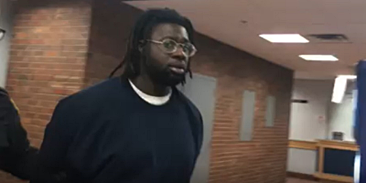
An Ontario man facing dozens of charges in a so-called grandparent phone scam in this province has been released on bail.

Twenty-four-year-old Charles Gillen is accused of travelling to St. Johns to collect money from people, mostly nans and pops taken in by the fake sob stories
​
But the third time proved a charm yesterday when, in ​the greatest of ironies, Gillen, a grandson in jail for real, was bailed out by his own grandparents.
SOURCE

12/23/2023

Artificial Intelligence

Scams targeting older Americans, most using AI, caused over $1 billion in losses in 2022

Picture
Older Americans reportedly lost $1.1 billion to fraud in 2022, according to the annual Senate Committee on Aging report released this month, and most of the scams utilized AI technology to clone the voices of people they knew and other AI-generated ploys.

During a ... committee hearing on AI scams, committee chairman Sen. Bob Casey, D-Pa., published the group’s annual fraud book highlighting the top scams last year. It found that from January 2020 to June 2021, the FBI found “individuals reportedly lost $13 million to grandparent and person-in-need scams.”

Sen. Elizabeth Warren, D-Mass, also a member of the committee, said the $1.1 billion figure in total losses is “almost surely an underestimate,” since it does not factor in the instances of victims who don’t report scams due to embarrassment.
Casey said in a statement that “federal action” is needed to put up guardrails to protect consumers from AI-generated scams. There are currently very little regulations on AI capacities, which witnesses urged lawmakers to crack down on through legislation.

What is AI?
“Any consumer, no matter their age, gender, or background, can fall victim to these ultra-convincing scams, and the stories we heard today from individuals across the country are heartbreaking,” he said. “As a parent and grandparent, I relate to the fear and concern these victims must feel.”

The top 10 categories of scams reported in the fraud book were financial impersonation and fraud, robocalls, computer scams, catfishing on dating profiles, identity theft and others.

The most prominent scams used AI technology to mimic people’s voices who then make calls to the victims, family members or loved ones, asking for money. Several testimonies from witnesses in the hearing said they received calls that sounded exactly like their loved one was in danger, was injured or was being held hostage.

Tahir Ekin, PhD, director of the Texas State Center for Analytics and Data Science, who was present at the hearing, testified this deliberate strategy of impersonation catapults “their believability and emotional appeal.”
SOURCE


​AI trends: What experts, execs think about AI

Though artificial intelligence has been around for decades, the introduction of ChatGPT — a consumer-facing AI chatbot — in late 2022 brought the technology to the forefront throughout 2023. 
​
ChatGPT, which gained more than 100 million users within two months of its launch, set off an AI arms race across the tech sector as startups and giants alike raced to perfect and ship usable competitors. Google (GOOG) -Get Free Report rolled out its Bard chatbot and started shipping AI enhancements to its suite of products. …
READ ON …

12/22/2023

Scams

​Keep your money safe from gift card scammers this holiday season. Here’s how​

Picture
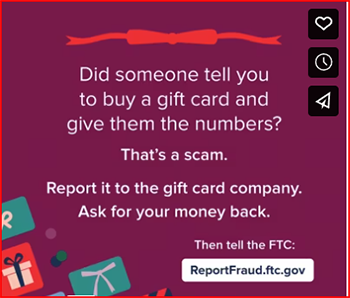
What’s one way to keep your money safe from scammers during the holidays? If you’re in the check-out line buying gift cards, make sure they’re for gifts. Only gifts. Not because someone tells you to buy gift cards and give them the numbers off the back of the card. Only scammers say that.
 
Gift card scams start with a call, text, email, or social media message. It’s usually for something urgent and they want you to pay right away. Scammers might say they’re from the government or a company you know. Or, thanks to AI voice cloning, they might even sound just like the friend or family member they call pretending to be, asking you to send money to fix their emergency. No matter what they say, it’s a trick to get you to go to a store, put money on a gift card, and give them the numbers. It’s a scam.
 
If you think you gave a gift card to a scammer, act fast. Grab your gift card and gift card receipt, then:
  • Report the gift card scam to the gift card company. It doesn’t matter how long ago the scam happened.
  • Ask for your money back. Some companies are helping stop gift card scams. They might give your money back. It’s worth asking.
  • Tell the FTC at ReportFraud.ftc.gov. Your report makes a difference and helps protect people in your community from fraud and scams.
And what about those free gift card offers? Lots of scammers send phishing emails promising free gift cards in exchange for your personal or financial information. Save your money. Don’t click on any text or email links.
 
So: gift card for your 17-year-old niece who’s impossible to buy for? Sure. Gift card for the person who just called with an urgent reason to go get a card and share the PIN numbers? Heck no.
SOURCE

12/21/2023

Scams

Visa Scam Alert

Picture
Scammers prepare all year for the holiday season so they can take advantage of increased activity and people who let their guard down while shopping, Visa said.

Visa cited advancements in artificial intelligence, increased foot traffic at stores and a higher demand for goods as some of the reasons that scammers are likely to prey on consumers both in person and online. Their tactics include phishing schemes that, at first glance, closely mimic legitimate retailers and promotions but end up leading unknowing consumers to click through and risk exposing their personal information, the company said.

But various types of scams have been on the rise and require a whole new level of discernment on the part of the average consumer. For example, recent data from the Federal Trade Commission shows that online shopping scams accounted for 44% of all social media scams in the first half of 2023. AI is similarly responsible for the increase in phone scams, with the average cell phone user receiving 14 spam calls per month.
​
READ FULL ARTICLE

12/16/2023

Artificial Intelligence

How to spot artificial intelligence-generated content.

Picture
In a world where technology is growing, people may come across fake images or even videos of celebrities, politicians, coaches, and more.

These videos are mostly for comedic content but can also be used as a way to scam people or to make people believe this “real” person said something they never said.

This recently occurred in November 2023 when a sponsored video of “Gordon Ramsay” appeared on TikTok.
 
This video claimed to show Ramsay telling people they could get 100% off cookware, [But it] was not Gordon Ramsey. it was an artificial intelligence (AI) version of Ramsay being used to steal people’s identities.
 
With the 2024 Presidential election fast approaching, [you] should be on the lookout for AI versions of any politician. This can include videos, images, or even just the voice of any politician.
​
According to the Better Business Bureau (BBB), the following tips will help you identify if the video or image you see on social media/the internet is AI-generated:
  • Find a high-resolution image and zoom in
  • Look for asymmetry and other physical inconsistencies
  • Strange textures or a glossy effect
  • Look out for strange shadows, blurs, or light flickers
  • Unnatural body language
  • Take a closer listen
The BBB also states that the best ways to verify if the photo/video is real is to check the source, do a reverse image search, and be prepared for change. …
READ MORE

12/15/2023

Scams

​Last-minute shopping? Three ways to spot rip-offs.

Picture
Ever think about clicking on ads for big markdowns or close-out sales? Social media seems to know what’s on your shopping list, whether it’s the season’s hot toys, electronics, or other popular items. The problem? Scammers are impersonating real companies in ads on Facebook, TikTok, and other social media platforms. So, how do you navigate past the fakes without passing up the real bargains? 

If you’re in a race to finish your holiday shopping, you might be interested in ads that promise great deals from companies you know and trust. But if you order, you’re likely to get a knockoff, poorly made item, or nothing at all, because it wasn’t the company at all: it was a scammer. Here’s how to spot their phony ads:
  1. Do some research before you buy. Unusually low prices are a sign of a scam. If you see an ad for a familiar company but you’re not sure the ad is real, go to the company’s website using a page you know is official — not the link in the ad.
  2. Pay by credit card, whenever possible. Credit cards offer more protection, and you can dispute charges if what you get is not what you ordered, or you get nothing at all.
  3. Know only scammers demand you pay with gift cards  wire transfers through companies like Western Union or MoneyGram, payment apps, or cryptocurrency. Sending money that way is like sending cash. It’s nearly impossible to get it back if there’s a problem. But reporting the scam as soon as possible increases your chances of getting your money back.
READ MORE

11-26-2023

Scams

Younger age groups report falling for online ID theft, fraud scam

Picture
The holidays are primetime for scammers, and … recent attacks are impersonating banks.
 
Trend Micro Research says they’ve detected a wave of fake emails impersonating American Express, telling people they need to click on a link to verify their account.
 
This type of scam email looks like a transaction notification from [for example] the Navy Federal Credit Union, but don’t click on the link. It leads to a copycat version of the bank's website that will steal your login credentials.
 
According to the Consumer Report Sentinel Network, cyber-attacks can increase to 70% in November and December.
READ FULL ARTICLE

11/09/2023

​Elder Fraud, AI Voice Hello Grandma

​How to avoid being tricked by a familiar voice ‘Grandparent scams’

Picture
You may have heard about older adults being tricked into sending money to someone they think is a grandchild or other relative in trouble and thought to yourself, “How could anyone fall for that?” But the truth is, today’s advanced technology makes it easier than ever for scammers to trick their unsuspecting and well-meaning victims.
​
To protect yourself, it pays to understand how fraudsters work, what red flags to look for, and how to trust your instincts so you don’t end up on the losing end of one of these vicious scams.

The A.I. twist
Because of advances in artificial intelligence (A.I.), criminals can now make their pleas for cash sound even more convincing when calling on the phone. According to the Federal Trade Commission, these scammers use A.I. voice cloning software to mimic your relative’s voice by pulling the audio from their social media videos.

Unfortunately, scammers often couple this tactic with a “spoofed” phone number that shows up on your caller ID with your relative’s name, so it looks like it’s really them calling you.

How to spot red flags
  • Late-night calls.
  • Urgent pleas for money.
  • Requests for odd methods of payment.
If you’ve been affected by crime that involves the U.S. Mail®, contact the United States Postal Inspection Service at 877-876-2455 or report it online at USPIS.gov/report.
READ MORE>>

11/08/2023

Elder Fraud, Extradited Suspects

Multiagency case sends 2 Nigerian nationals to prison for international scheme that defrauded elderly US victims.

Picture
Two Nigerian nationals who were extradited to the United States from Spain were sentenced to 128 and 87 months in prison for their roles in a transnational inheritance fraud scheme. With this sentencing, five defendants who were extradited from the United Kingdom and Spain in connection with this matter have been sentenced.

When criminals indiscriminately target the elderly or otherwise vulnerable, the impact and harm is particularly long-lasting.
READ NEWS RELEASE


Elder Fraud: Tech Fraud

Tech scams are financially devastating to senior citizens

Picture
Since our lives are ruled by our computers and all of the personal and financial data that flows in and out of them, we are right to be concerned about computer safety and guarding against a virus or spyware.

In the latest iteration of this elder scam, bad actors groom the victims over weeks and months that their trusted financial advisors are under investigation and cannot be trusted. The victim is coaxed to give their money to the fraudster with a warning that they say nothing, or risk being harmed or going to jail.

The elder tech scam can go down a number of paths, but they each end with significant financial loss.

Here are tips on how to deal with computer safety and tech support:
  • Do not call phone numbers on pop-up ads about computer security.
  • The best way to keep your computer safe from viruses is to update its security software.
  • If you have concerns about the security settings or viruses on your computer, take it to a reputable brick and mortar computer repair business and ask them to sweep your computer for remote access software and other harmful software.
  • If you get a pop-up ad that takes up your screen, has no way to close and suggests you click on it as the only way to rid the screen of the intrusion, take the computer to a professional repair shop.
...
READ MORE

11/07/2023

Scams Veterans

​AARP Backs Tougher Penalties for Fraud Targeting Veterans

PictureImage source: AARP Article
Military consumers have lost $851 million to scammers since 2019 — nearly half of that in 2022 alone, according to the Federal Trade Commission.

Criminals posing as veterans often steal money from military families by tricking them into donating to fake veterans’ charities. Scammers have convinced veterans to sign over their pensions or disability benefits or have charged them phony fees for filing claims on their behalf.
​
That’s why AARP endorsed bipartisan legislation this week that would stiffen the penalties against these con artists. The Veterans Protection From Fraud Act would increase penalties up to 10 years in prison for fraud targeting a veteran. The bill was introduced in the U.S. House in June and the U.S. Senate in July.
READ MORE


​Military and Veterans Assistance Program Complaints

Picture
A special unit, a "Senior Protection Team" was created in the Office of the Florida Attorney General to assist veterans who are fraud victims in Florida. Although this pertains to Florida, other states may have a similar resource.
​
So, if you, or someone you know, is a victim of fraud in Florida, aside from reporting it to your local law enforcement agency, please refer them to the OAG and click on the “FILE COMPLAINT” button. 

11/06/2023

Picture

Scams: AI Fraud Detection

​How AI Will Revolutionize Financial Fraud Investigation

Financial fraud is increasing at an alarming rate. And prosecutors are still struggling to catch up with the "tidal wave of pandemic fraud."

A staggering 70% of financial institutions were fleeced for over $500,000 within a year.
​
Additionally, Wells Fargo's $3.7 billion penalty reveals a horrifying web of "illegal activity." There were 16 million client accounts mismanaged, which included wrongful foreclosures, illegal vehicle repossessions, surprise fees and predatory overdraft charges.

Traditional methods of investigating financial fraud rely on manual verification and human analysis. Unfortunately, these methods often fall short when dealing with today's increasingly complex and sophisticated fraud schemes. These shortcomings make it imperative to explore the transformative potential of artificial intelligence and machine learning for revolutionizing financial fraud investigations.

AI's Breakthrough in Financial Fraud Investigation
Let's uncover the versatile applications of artificial intelligence (AI) in redefining the boundaries of financial fraud investigation.
 
Entity Link Analysis
By leveraging AI algorithms through entity link analysis, investigators can analyze relationships between entities, identify suspicious patterns and visualize intricate connections.
​READ FULL ARTICLE

Scams: How AI is used to fight scams

How AI and Machine Learning Help Detect and Prevent Fraud

In a world that's growing more digital and interconnected by the day, fraud has taken on new dimensions, often dealing crippling blows to business. From online transactions to sensitive data protection, it's become vital to stay one step ahead of cunning fraudsters. Thankfully, we have an ace up our sleeves in the form of artificial intelligence (AI) and machine learning (ML) that are championing the fight against cybercrime and its various iterations.

AI And ML Fraud Detection
Let’s start with the way AI deals with payment fraud. Merchant losses are projected to reach $38 billion in 2023, driven by credit card fraud, phishing, chargebacks and identity theft, to name a few scheming ways.

Bespoke fraud ML In models are powered by algorithms that learn from historical data, picking up on behaviors and characteristics commonly associated with fraud. They can identify abnormal patterns, such as unusually high transaction amounts, frequent purchases in unusual locations or strange time intervals between transactions. Thanks to behavioral analytics that covers thousands of factors, it’s possible to momentarily discern context from numerous parameters and accurately identify fraudulent transactions. 
                      
The Deepfake Challenge
Then, there is the “most entertaining” fraud of them all: deepfakes.
 
Video and image generation models allow fraudsters to create convincing deepfakes, which can represent a real person in particular contexts. Fraudsters can impersonate someone trusted, such as a company executive, friend or family member, and lure unsuspecting victims into performing specific actions. These usually are transferring funds to fraudulent accounts or sharing confidential information, routinely leading to financial and/or reputational damage.

Artificial intelligence tackles the deepfake problem through deep learning that takes anomaly detection to an entirely new level. It can process complex and high-dimensional data that is media of all kinds and detect irregularities and intricate patterns within.
 
Deep learning techniques, such as convolutional neural networks (CNNs) and biometric liveness detection, ensure that technology is reading a genuine biometric source, whether it’s a human face, an actual eye or a thumbprint, as opposed to a recreated image of one.
READ FULL ARTICLE           

11/05/2023

​Elder fraud Sweepstakes scam

Jamaican National Indicted for Sweepstakes Scheme Targeting Elderly Victims

Picture
Vanessa Roberts Avery, United States Attorney for the District of Connecticut, and Ketty Larco-Ward, Inspector in Charge of the U.S. Postal Inspection Service, Boston Division, today announced that a federal grand jury in New Haven has returned a seven-count indictment charging HOWARD CHAMBERS, 32, a citizen of Jamaica residing in Waterbury, with fraud and money laundering offenses stemming from his alleged participation in a sweepstakes scam that defrauded primarily elderly victims across the country of millions of dollars.

The indictment charges Chambers with one count of conspiracy to commit mail fraud and wire fraud, five counts of mail fraud, and one count of conspiracy to commit money laundering.  Each of these offenses carries a maximum term of imprisonment of 20 years.
READ PRESS RELEASE


Grandparent Scam

​So-called ‘grandparent scams are becoming more sophisticated.

Picture
Fraudsters are using A.I. to make their scam calls sound more authentic.

Also called “grandparent scams”, the schemes typically target seniors. A common scam involves an emergency of some sort, and while the actual details can vary, they all follow a similar formula, with suspects using high-pressure tactics aimed at convincing victims that a family member is in serious or life-threatening trouble and needs money sent to them immediately.

One well-known variant involves someone calling the victim and pretending to be a family member who has been jailed and needs bail money. In another version, the “family member” or “friend” is supposedly on vacation and has lost their wallet (or had it stolen) and needs a cash transfer for temporary funds.

Another scenario is that the caller must return home suddenly due to an emergency and needs money for a plane ticket. Callers also claim that they have been involved in a car accident or similar dire predicament and need funds immediately.
A new twist is that the voice used in the phone call has been altered to sound more authentic using digital manipulation, likely with the help of A.I. (Artificial Intelligence). These tools mimic voices from data that is largely coming from public social media accounts, meaning that the person calling sounds like whoever they are impersonating.

There are several steps that can be taken to protect your loved ones from falling victim:
  • Stay connected with the seniors in your life. This prevents isolation, which can make them more vulnerable to scammers.
  • Warn seniors not to share sensitive information, and help them create strong, unique passwords.
  • Monitor their monthly banking statements for signs of unusual/unauthorized payments.
  • Advise them to contact a trusted person if they receive an unexpected request for a sudden cash transfer or reach out directly to the person who is said to be involved (or their family) to see if the story is true.
  • Warn other family members and friends if a loved one has experienced a scam attempt.
​​READ FULL ARTICLE

11/04/2023

Cybercrime

Cybercrime scams for all ages

Picture
​What the Tech, Cybercrime scams for all ages.

“Okay, boomer”. Younger generations may shake their heads in disbelief that their parents and grandparents have fallen for a cyber scam.

But maybe those younger people can learn a thing or two about cybercrime from their elders. Millennials, Generation X, Generation Z, and even post-millennials (those born after 2000) are more susceptible to scams than their predecessors.
In some cases, more than twice as likely to get swindled by cyber scammers.

It’s true, according to both the Federal Trade Commission and the Better Business Bureau.

Seniors are also more likely to send scammers money using gift cards. Boomers may lose the most money, but they don’t get scammed as often as their kids.
​MORE ON THIS


Elder Scams

​Older family members may be victims of cryptocurrency scams.

Picture
Here's are quick tips to spot if an elderly family member or friend has become a victim of crypto fraud.

FBI research shows crypto crime is skyrocketing, especially with seniors.
  • In 2022, American senior citizens lost over $1 billion to those types of scams.
  • Watch for loved ones opening a crypto account without showing much knowledge or experience with this type of currency.
  • Ask if purchases are funded by their retirement account savings. If an older person in your life making large cash withdrawals from their bank account for crypto currency.
  • Avoid investing with anyone who reaches out to you and thoroughly research any investment opportunity before giving money. You may also want to reach out to a financial planner for guidance.
READ MORE

11/03/2023

Romance Scams

Are you in a romance scam?

Picture
Scammers are criminals who will say and do anything to steal your money. Probably the lowest scam out there is the romance scam.

Due to divorce, separation or death of a partner, you find yourself lonely to the point of desperation. You’ve heard that people meet new partners on social media, on online dating sites and you decide to give it a try. After all, no harm in seeing if there is someone out there, somewhere in the world, for you.

As these thoughts are going through your mind, thousands of seasoned crooks from around the world have laid traps to drain your bank account, and in the end, rip your heart out.

In 2020, romance scams increased by 50%, with victims reporting losses of $304 million. Average victim losses largely depend on the amount of financial assets owned by an individual. Wealthy people routinely lose more than a million dollars in a romance scam before they realize something is wrong.

But romance scammers also prey on older adults with relatively little in savings, and may spend months working to relieve a retiree on a fixed income of the few thousand bucks they’ve put aside for a rainy day.

The FBI reports that online romance scams continue to grow because of the money involved. Out of all the scams out there, victims suffer the greatest financial losses from romance scams.

The perpetrators of romance scams are ruthless and weave their evil webs using the psychology of loneliness.
 
Typical Steps
  1. You visit a dating site on the internet, share some details about your life, and post it for everyone to see.
  2. Surprisingly quick, you receive a reply from someone, usually living overseas (or so they say), who shares your loneliness, understands your situation and tries to establish regular contact. Internet romance scammers move quickly, and the usual ploy is to get you to move communications from a dating site to text messaging.
  3. The criminals use inexpensive software to hide their actual identity and location, but relentlessly pursue you through text messaging. When you ask to have a video chat with your new love, there is always a reason it can’t be done.
  4. The scammer is aware of your brain chemistry and the reactions that quickly make you dependent on them and begin to trust the new love you don’t really know anything about. When trust is established, the scammer starts asking for money.
  5. Knowing you are lonely, the scammer promises to come to visit, or even to marry you, but…
  6. There is always a “but.”

The reason given why that promised visit can’t be made will usually be attached to a need for money, such as, replacing a lost passport, buying an airline ticket, paying for medical care, getting a visa, or helping with a business investment.

Once you’ve sent a scammer money, no matter how small, the reasons for more money never stop — until you wake up to the fact you’re being duped, or just run out of money to send.

Romance scammers usually tell victims to send money via cash, gift card or wire transfer. Once the money is sent — it’s gone forever. ...
​MORE

11/01/2023

​Elder Fraud

Seniors more susceptible than ever to tech scams, online fraud

Picture(Credit: Sean Gladwell/Getty Images)
Seniors are more susceptible than ever to tech scams, online fraud, FTC report shows.

Tech scams are among the most common, and costliest, kinds of fraud that older adults fall victim to, and their losses more than doubled over the past two years, a new report shows.

Adults aged 65 or more years who fall victim to fraud scams lose, on average, more than $1,000 annually, according to a new report sent to Congress this week from the Federal Trade Commission.

“We do all we can to protect older adults and shut down the scams targeting them,” Samuel Levin, director of the FTC’s Bureau of Consumer Protection, said in a statement. “But we still need Congress to restore our authority to get money back from the scammers and into consumers’ pockets.”
READ MORE


Elder Fraud

​Indian hacker arrested in US for stealing $150k from elderly woman.

PictureImage Source: Article
A 24-year-old Indian national has admitted to his role in stealing $150,000 from an elderly woman in the US state of Montana through a computer-hacking scheme.

Sukhdev Vaid pleaded guilty on Tuesday to wire fraud, and faces a maximum of 20 years in prison, a $250,000 fine and three years of supervised release.

The fraud occurred because of a pop-up notice that appeared on Jane Doe’s computer screen, which said it was ‘haked’ and asked Doe to call on a number for customer support.

Doe complied, and fraudsters directed her to remove cash from her bank accounts for safe keeping at the “Fed.”

Doe complied and gave $150,000 in cash to the fraudsters, US District Judge Donald W Molloy heard.
he fraudsters, US District Judge Donald W Molloy heard.

The investigation determined that the fraudsters remotely accessed Doe’s computer using UltraViewer, which they installed on her computer.
READ MORE

10/16/2023

Consumer Credit

You now have permanent access to free weekly credit reports.

Picture
The three national credit reporting agencies — Equifax, Experian, and TransUnion — have permanently extended a program that lets you check your credit report at each of the agencies once a week for free.
 
Visit AnnualCreditReport.com to request free copies of your credit reports. Other sites may charge you or be fraudulent sites set up to steal your personal information.
 
By law, everyone is entitled to one free credit report every twelve months from each of the three credit reporting agencies. In 2020, soon after the COVID-19 pandemic upended the finances of millions of people, the three agencies announced they would temporarily make free reports available every week. The program was extended twice and is now permanent.
 
Why check your credit report? Your report shows things like how many credit cards and loans you have, whether you pay your bills on time, and whether any debts have been turned over to collections. Creditors, insurers, some employers, and other businesses use it to decide if they want to do business with you — and the terms they’ll offer you.
 
Mistakes, like accounts or bankruptcies that aren’t yours, can hurt your credit, increase how much you’ll have to pay to borrow money, and even derail your chances of getting a loan, insurance, a rental home, or a job. Mistakes can result from errors by businesses that report credit information to credit reporting agencies. They also can be a sign of identity theft. The sooner you spot a mistake, the sooner you can dispute the error or — if it results from identity theft — report it at IdentityTheft.gov
READ FULL ALERT


Elder Fraud 

​Man Sentenced for Defrauding the Elderly in Romance Fraud Scheme.

Picture
A Woodbridge man was sentenced to 15 months in prison for conspiring to launder money in relation to romance and investment frauds. 
​
According to court documents, from 2014 to March 2019, Ishmael Kayede, 40, conspired and agreed with multiple co-conspirators to launder funds derived from mail or wire fraud schemes, including romance fraud, gold and diamond investment fraud, and other fraud scams. During his participation in this money laundering conspiracy, Kayede received funds in his bank accounts from victims of those romance and other fraud schemes while working with and at the direction of associates located in foreign jurisdictions, including Ghana.
READ PRESS RELEASE

10/14/2023

Elder Fraud

Connecticut Man Charged with Fraud Scheme Involving Elderly Victims

Picture
The indictment charges Matthew Ramos-Soto, 26, Hartford, Connecticut, with conspiring with others to defraud Wisconsin residents.  The indictment alleges that from October 24 to 28, 2022, unknown conspirators contacted elderly individuals by telephone and falsely claimed that a relative had been arrested following an accident and that money for bail was needed.  The indictment further alleges that Ramos-Soto and his co-conspirators traveled throughout Wisconsin to pick up cash in person from the targeted individuals.

The indictment alleges that the Ramos-Soto and his co-conspirators obtained approximately $200,000 during the five days of the conspiracy.
READ ON


ATM Skimming Arrest

​4 people arrested after police recover $33,000 in card skimming scam 

Pictureimage from article
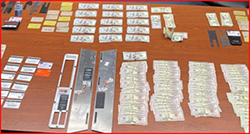
Detectives arrested 4 suspects: 32-year-old Michael Kasper Eriksen, 25-year-old Dorel Florin Hodeanu, 25-year-old Grag Jan and 26-year-old Alexandra Bianc Niculescustoian. These suspects, according to the CPD, were seen using fraudulent cards to withdraw cash from numerous banks located in the downtown Chico area.

Detectives found these subjects in possession of over 30 fraudulent cards, about $33,000 in cash, and ATM Skimmer placement and removal tools.
READ THE FULL ARTICLE FROM THE SOURCE

10/13/2023

Scams, Text Scams

​Understanding Social Engineering Tactics

PictureImage from article
Phishing is the most common social engineering tactic, where criminals send emails, texts, phone calls, social messages with requests for follow up to provide sensitive information. Through deceptive text messages and emails, these cybercriminals use psychological tricks like creating a sense of urgency and fear to manipulate you into revealing personal and financial data.

When it comes to bank-related phishing, the fraudsters typically want access to your login information such as passwords and PINs. They may also ask for account numbers and other personal details that can be used to access your bank account.

Remember that an authentic message from a bank will never request your username, password, social security number, or other sensitive information.
READ MORE


​Elder Fraud

​It’s a dangerous world out there

PictureAris Suwanmalee/AdobeStock. Image from article
The U.S. Department of Justice recently released the 2022 FBI Elder Fraud Report. It does not make for enjoyable reading. There were almost 90,000 victims of fraud over the age of 60 last year. And they lost in aggregate over $3.1 billion, an increase of 84% over 2021. What are some of the biggest scams and what can you do to protect yourself?

​
​

READ THE FULL ARTICLE

10/12/2023

Theft, Dumb Crooks, a sting operation?

Vacuum containing hundreds of hornets stolen from Philadelphia beekeeper's truck

Picture
The person who stole a shop vac from a truck in Philadelphia's Frankford neighborhood could be in for quite a surprise.

Don Shump, who owns the truck and vacuum, said there are hundreds of hornets inside of it.

"Whoever it was that grabbed this grabbed a shop vac that was filled with several hundred hornets," Shump said. "And not just the workers, they had a preponderance of queens," Shump said.
AND NOW, THE REST OF THE STORY


Scams - Gift Cards

Scammers prefer gift cards, but not just any card will do.

Picture
Gift cards are an easy way to give. Reports to the FTC’s Consumer Sentinel show they’re also an easy way to take. About one in four people who report losing money to fraud say it happened when a scammer tricked them into giving the numbers on the back of a gift card.

In the first nine months of 2021 alone, nearly 40,000 people reported $148 million stolen using gift cards.

Scammers favor gift cards because they are easy for people to find and buy, and they have fewer protections for buyers compared to some other payment options. Scammers can get quick cash, the transaction is largely irreversible, and they can remain anonymous.
​READ MORE

10/11/2023

Elder Financial Fraud

Virtually penniless: FBI warns of rising elder fraud crime rates as scammers steal billions in savings.

Picture
Americans over 60 are increasingly falling victim to crimes of fraud perpetrated online and over the phone at rates that add up to billions in losses each year, and federal investigators are warning that the scammers are becoming more sophisticated in the ploys they use to get their victims to hand over large sums of money.

An estimated $28.3 billion is lost to elder fraud scams each year, according to a recent AARP Study. It found that 72% — or more than $20 billion — is taken by individuals who are known to the victims, like family members, friends or advisers. The study says many of the scams that account for the nearly $30 billion lost go unreported, and the FBI is now urging anyone who encounters suspicious activity online to disengage and report the conduct to law enforcement.

Rich Brune — a 75-year-old retiree living in Virginia — told CBS News he fell for an online scam last year that cost him nearly $800,000. Sophisticated criminals posing as Microsoft workers contacted him online and told Brune his computer had been hacked, his financial accounts were compromised, and he needed to take urgent remedial action. 
​
Over a five-month period, the Navy veteran ...
​READ ON

10/08/2023

Fraud

​QR codes in emails? Watch out - it could be part of a 'Quishing' scam

Picture
A new email scam campaign is using QR codes to get your sensitive information. It's called "quishing" or  QR  phishing, and security experts say it's when fraudsters launch email campaigns that appear to have legitimate QR codes. But if you scan the QR code in that scam email, embedded is a malicious URL that will lead you to websites that contain malware or websites designed to steal your personal or financial information.

These emails typically come from what seems to be a well-known company or brand. But in reality, they're just copycats, and that's what makes quishing so successful. Many of these fraudulent QR codes lead you to believe you will get a discount or special offer.
READ MORE


Gift Card scams

​The FBI's Washington Field Office is warning consumers about the threat of online gift card fraud.

Picture
The FBI's Washington Field Office is warning consumers about the threat of online gift card fraud that typically occurs after the Holiday Season. This video explains a specific type of gift card fraud scam and what consumers can watch out for. If you believe you’re a victim of a gift card scam, report it to ic3.gov.

Fraudsters use many schemes to scam people out of their hard-earned money. 

One of those scams is through the purchase of gift cards. If someone asks you to purchase gift cards and then provide the redemption codes to them, it is likely a scam. The fraudsters use those funds to purchase goods and services which may or may not be legitimate and you will likely never get reimbursed for those gift cards. This type of scam can be combined with additional requests for wire transfer payments and can be part of other complex fraud schemes. 

Sometimes the criminals even claim to be law enforcement officials demanding payment or gift cards. Law enforcement will never demand or ask for payment.
WATCH THE VIDEO

10/07/2023

Scams

Tom Hanks, MrBeast and other celebrities warn over AI deep fake scams.

Picture
Instances of celebrities and public figures AI deep fakes continue to surface, with their likeness circulating the web promoting scams or products.

Hanks was the first of the three to identify the AI deep fake of himself after he posted a screenshot of the video on his Instagram page on Oct. 1, saying “beware” and that he had nothing to do with it.

The AI version of Hanks was created to promote what he called “some dental plan.”
​
On Oct. 3, YouTube personality James Donaldson, known as MrBeast, took to social media platform X (formerly Twitter) to denounce an AI-generated deep fake of himself. In this instance, MrBeast is seen promoting a scam for winning an iPhone 15 pro.
READ MORE

09/30/2023

Cause of Crime

The root cause of crime.

Picture
Many criminals are dumb, and some are crazy. But virtually all criminals pay attention to what concerns them the most: the likelihood of being caught and the severity of punishment for their crimes. Even the most deranged criminal does not commit his felony in front of a policeman. And the extent to which laws are enforced is the most important variable influencing whether laws are broken.

In one sense, the root cause of all crime is the human propensity to do evil. But the root cause of fluctuations in crime rates–the cause of our current spike in violent crime–is a weakening of social norms, a failure of will, and a resulting lack of law enforcement. Crime must be followed by punishment that fits the crime. When that doesn’t happen, crime proliferates. And 18-year-old wise guys think they can get away with murder.
​SOURCE

09/29/2023

Elder Fraud

Scams just keep coming.

Picture
In the world of scams, just when you think scammers can't possibly come up with new ideas, they do.
​
One of the worst now is the fake fraud alert for protection services. You'll get an emergency message or call saying that someone is trying to access your account. The "helper" from your "bank" asks if you want to temporarily transfer your money to a safe, protected account while officials work it out, and you say yes. And ... there goes your money, never to be seen again. If you ever get a call such as this, hang up and call your bank to ask if they called you.

And then, of course, there are all the old standard scams. There is the grandparent scam where a thief calls and pretends to be a grandchild who is in jail and desperate to be bailed out.

There is the romance scam where a supposed suitor pretends to get close to you over time and then asks for money or wants to do a joint financial investment. And the driveway repaving/home repair scam where they promise to do a fine job on the work, but you'll need to pay a bit upfront for materials and supplies. And lest we forget, there are the computer repairs wherein they need remote access to your computer, the work from home scams, fake Amazon text alerts, etc.

Beware of any calls or text messages that push you to act now, that insert urgency or fear into the situation. Don't fall for it. Hang up and don't click links. Make a call yourself to see if the situation was legitimate and carefully delete the text message.
To learn about even more current scams, check AARP at aarp.org/money/scams-fraud/info-2023/top-scammer-tactics-2023.html.

With the holidays coming, the scams are just going to get worse. Stay alert!
SOURCE

09/27/2023

Elder Fraud

Three Nevada Men Sentenced in Multimillion-Dollar Prize Notice Scheme

Picture
LAS VEGAS – Three men were sentenced on Friday in Las Vegas, Nevada for perpetrating a prize-notification scheme that stole more than $10 million from elderly and vulnerable victims. Mario Castro, 55, of Las Vegas, Nevada, was sentenced to 240 months in prison. Miguel Castro, 58, of Las Vegas, Nevada, was sentenced to 235 months in prison. Jose Luis Mendez, 49, of Henderson, Nevada, was sentenced to 168 months in prison. In April, a jury found the three men guilty of conspiracy to commit mail fraud and multiple individual counts of mail fraud.
READ DOJ RELEASE


AI Scams

AI voice cloning scams on the rise, expert warns

Picture
AI-powered voice cloning has increased over the past year as technology has advanced.

Fraudsters carrying out voice cloning scams will record a person’s voice or find an audio clip on social media or elsewhere on the internet. "All they need is as little as 3 seconds, 10 seconds is even better to get a very realistic clone of your voice," Explains Mike Scheumack, the chief innovation officer at identity theft protection and credit score monitoring firm IdentityIQ.

The audio sample is then run through an AI program that replicates the voice, allowing the scammer to make it say whatever they type in addition to adding laughter, fear, and other emotions into the cloned voice depending on how the scam is scripted.
​READ MORE ABOUT THIS


Elder Fraud

Social Security scams (and how to avoid them)

Picture
Social Security is a critical safety net for retirees in the United States. The financial support provided by the Social Security program offers many seniors the stability necessary during their golden years — and in some cases, these payments may be their primary source of income during retirement.

One of the most prevalent Social Security scams involves impostors posing as SSA officials. Scammers may reach out via phone, email or even in person, claiming there is a problem with your Social Security benefits. They often use fear tactics to pressure you into providing sensitive personal information, like your Social Security number or bank account details.
  1. The impersonation scam.
  2. The fake Social Security card scam.
  3. The threat of benefits suspension scam.
  4. The investment opportunity scam.
  5. Other ways to protect yourself from scams.
READ MORE ON HOW TO AVOID THESE SCAMS


09/22/2023

Dumb Crooks

​Wanted man, Christopher Wallace, posts his hideout on snapchat in a classic act of stupidity

PictureChristopher Wallace (Image from article)
We all perform certain acts of stupidity throughout our life. But when it comes to fearing getting locked up in jail, would you post your location on social media and make it so easy for the police to find you? A majority would say no, but there’s a man named Christopher Wallace who posted his hideout’s location on Snapchat! Read on to find out more!

For several weeks, the Somerset County police were searching for a man by the name of Christopher Wallace. Apparently, Wallace was suspected of being involved in a burglary that took place in January 2015.
 
Christopher Wallace, 24, was apparently involved in a burglary of cooking equipment. According to police reports, the burglary took place in January 2015 and ever since the Somerset County police have been looking for Wallace. Wallace was thought to be guilty of stealing a propane cooking stove and a cast iron wood stove from a Pierce Pond Township camp. Even after almost two months after the burglary, the police were still not able to locate Wallace.
​READ MORE ABOUT THIS


Elder Fraud Arrest

Two Indian Nationals Each Sentenced to 41 Months in Prison for Receiving Over $1.2 Million in Global Robocall Scam that Defrauded Elderly Victims

Picture
Two Indian nationals were each sentenced today to 41 months in prison for their roles in a conspiracy to commit wire fraud by accepting illegally obtained $1.2 million in wire transfers from victims across the United States, U.S. Attorney Philip R. Sellinger announced.

“These defendants and their conspirators preyed upon some of our most vulnerable citizens, using trickery and threats to coerce them into sending money. Protecting our elderly population from these kinds of deceitful robocall scams is a priority of our office. Those who engage in this kind of elder fraud scheme can expect to face justice.”
READ MORE

09/20/2023

FTC Announcement

FTC Announces Claims Process for Fortnite Players Who Were Charged for Unwanted Items

Picture
The Federal Trade Commission has begun notifying people who may be entitled to compensation stemming from a settlement finalized in March 2023 with Epic Games over allegations that the Fortnite video game maker used dark patterns and other deceptive practices to trick players into making unwanted purchases.
 
In a complaint first announced in December 2022, the FTC alleged that Epic games deployed a variety of design tricks aimed at getting consumers of all ages to make unintended in-game purchases. The company also made it easy for children to rack up charges without parental consent and locked the accounts of consumers who disputed unauthorized charges with their credit card companies.
 
The money provided as part of the $245 million settlement with Epic Games will go to provide refunds to consumers. The FTC has begun the process of notifying more than 37 million people by email that they may be eligible for compensation, a process that will take one month to complete. Consumers will have until January 17, 2024 to submit a claim.
 
The Commission’s interactive dashboards for refund data provide a state-by-state breakdown of refunds in FTC cases. In 2022, Commission actions led to more than $392 million in refunds to consumers across the country.
MORE INFORMATION


ATM Skimming

Group tied to skimming scheme linked with Romanian crime syndicate.

Picture
Group tied to skimming scheme linked with Romanian crime syndicate, warrants say.
Investigators have identified four people of interest so far in the widening investigation into a skimming scheme across the greater Baton Rouge area.
 
The WAFB I-Team obtained police documents that detectives say tie two Texas residents - Ionut Fluerasu of Houston, and Pascu Eduard of Los Fresnos - to the scheme. Warrants have also been filed for two others - Iulian Zlataru and Ana Marie Dote.
 
According to the warrants, members of the group were allegedly caught on camera removing skimming devices from an ATM at Neighbors Federal Credit Union on Perkins Road back in May.
​MORE INFORMATION

09/19/2023

Malicious Mischief

The Bear Truth

PictureThe black bear and her three cubs at the scene of the crime. (Voyageurs Wolf Project)
The same family of bears won't stop wrecking trail cameras — and have been caught in the act five times on video. 

The same family of black bears in Voyageurs National Park won't stop messing with trail cameras.

The Voyageurs Wolf Project said the bears have attacked their cameras five times in the past year.

Sometimes the bears knock them over and move on, other times they fully chew on and destroy them.
READ MORE


Insurance Scams

Don't fall for these common car insurance scams.

PictureImage from article
Although this article is from Canada, this can happen to you.
Drivers throughout Canada are increasingly aware of the threat of insurance scammers. In Ontario, for example, a poll conducted by the Financial Regulatory Services Authority of Ontario earlier this year found that 75 per cent of insured drivers feel insurance scams are widespread in their province — but only one in five surveyed knew how to and where to report an incident.
  • Staged collisions
  • Shady collisions are a frequent route for scammers looking to claim insurance payouts. There are several types of staged collisions to watch out for.
  • Rear end collisions: When a scammer intentionally slams on their breaks, causing the car behind to hit them.
  • Wave and hit: A scammer waves a target driver through an intersection or parking lot entrance, then quickly moves their vehicle into their path to cause a collision.
  • Planted witnesses: Any targeted or staged collision could make use of a planted witness who will go on record in defense of the scammers.
READ THE FULL ARTICLE

09/16/2023

Elder Fraud

Police chase and crash linked to alleged Elder Fraud investigation

Picture
On Sept. 14, Auburn [Alabama] Police arrested Anshul Kumar, age 19, and Dhrumilkumar Vyas, age 23, both from Ringgold GA, on warrants charging each with seven counts of alleged financial exploitation of the elderly first degree, one count of attempted financial exploitation of the elderly first degree and criminal impersonation. Vyas was also charged with attempting to elude and reckless endangerment.
​
The arrests stem from Auburn Police receiving a report of a possible scam on Sept. 12, 2023. A complainant reported the suspects had been in contact with a victim who was over the age of 60 and the suspects used deception to obtain thousands of dollars from the victim. Auburn Police say they contacted the victim and investigators confirmed the suspects had perpetrated this scam multiple times.
VIEW THE MEDIA PIECE


Elder Fraud

Man Sentenced to Over Five Years in Federal Prison for Nationwide Scheme that Defrauded Elderly Victims of More Than $2.5 Million

Picture
A Florida man was sentenced in Maryland to over five years in federal prison for a nationwide scheme that defrauded elderly victims of more than $2.5 million.

The defendant was part of an International “Grandparent Fraud” scheme where conspirators collected over $2.5 Million in cash Payments by falsely telling victims that a relative—typically a grandchild—needed money for bail, legal fees, and other expenses.

Witnesses testified that during the telephone calls, the conspirators directed victims to send cash to particular addresses via an overnight delivery service.  The conspirators even posed as the victims’ relatives to further induce them to send the cash.  Once the victims did send money, the conspirators called the victims asking for more cash, regularly obtaining tens of thousands of dollars from the retirement savings of victims.  To prevent the victims from sharing the information with anyone, the conspirators told the victims that a “gag order” had been placed on the case requiring secrecy, or that the situation was embarrassing for the grandchild, and they didn’t want anyone else to know about it.
READ THE PRESS RELEASE

NEWSROOM ARCHIVES
P.O. Box 3322, Victoria, TX 77903
​
email inquiries: [email protected]
​© The National Association of Bunco Investigators Inc. All rights reserved.
Privacy Policy     |     Terms & Conditions
  • Home
  • About Us
    • Board of Directors
    • What we do
  • Cons And Scams
  • Contact Us
  • Donate
  • Helpful Links
  • Members Only
    • Welcome
    • Membership Directory
    • Photo Album
    • Crimes
    • Galleries
    • Investigative Resources
    • Law Enforcement Members >
      • Intelligence Logs
      • Renew Now
      • Search
      • LE Bulletins
    • Associate Members >
      • Associate Logs
      • Associate Members Bulletins
      • Renew Now
    • Search
  • Join NABI
  • Crime Categories
  • NABI Store
  • Training And Conferences
  • New Page